All projects
Research Project

Misinformation

I have a long-standing interest in understanding why individuals adopt propaganda and embrace false beliefs. Specifically, I want to understand the reasons why people cling to inaccurate beliefs, often fueled by misinformation and fake news.

In a series of studies, I investigated whether ‘intellectual humility’—the willingness to recognize that one’s beliefs might be incorrect—could serve as a protective factor against the adoption of false beliefs. I explored whether this trait could steer individuals away from inaccuracies and toward truth, for instance, regarding the safety of vaccines or debunking unfounded claims about the 2020 U.S. Election being rigged. While my research revealed that intellectual humility does aid in gravitating toward accurate information, it also suggested that this trait might lead individuals to adopt any claims for which there is support, regardless of the veracity of those claims.

In addition, I’m investigating various interventions’ effectiveness in mitigating the acceptance and dissemination of fake news, contributing to the broader understanding of how to combat misinformation.

Misinformation project image
Talk

Misinformation has life-or-death consequences

The real harms of falsehoods, including political violence and fatal health behaviors

How we can combat their spread

Why social media regulation is critical

Talk

Can intellectual humility shield us from false beliefs?

Help us recognize when we’re wrong

Open us to convincing counter-information

Change deeply held false beliefs

Relevant Publications

All publications

Journal of Experimental Psychology: General · 2026

Toward a mechanistic understanding of false news sharing: Which interventions work best, for whom, and why

Gollwitzer, A., Tump, A. N., Martel, C., Deffner, D., Sultan, M., Kurvers, R., & Hertwig, R.

This study examines how to curb false news sharing, drawing on news-sharing decisions from over 1,100 U.S. participants. Comparing leading interventions head-to-head and using drift-diffusion modeling to uncover the decisions behind sharing, it finds that warning labels and media literacy tips substantially improve sharing quality, while social norm cues have a modest effect and accuracy prompts a very subtle one. These benefits hold broadly—even among at-risk groups like conservatives. Critically, each intervention works through a distinct cognitive pathway: warning labels shift people’s initial intentions away from sharing before they engage with content, whereas media literacy tips operate later, improving how news is processed and increasing caution before a decision. The findings clarify which interventions work best, for whom, and in which contexts.
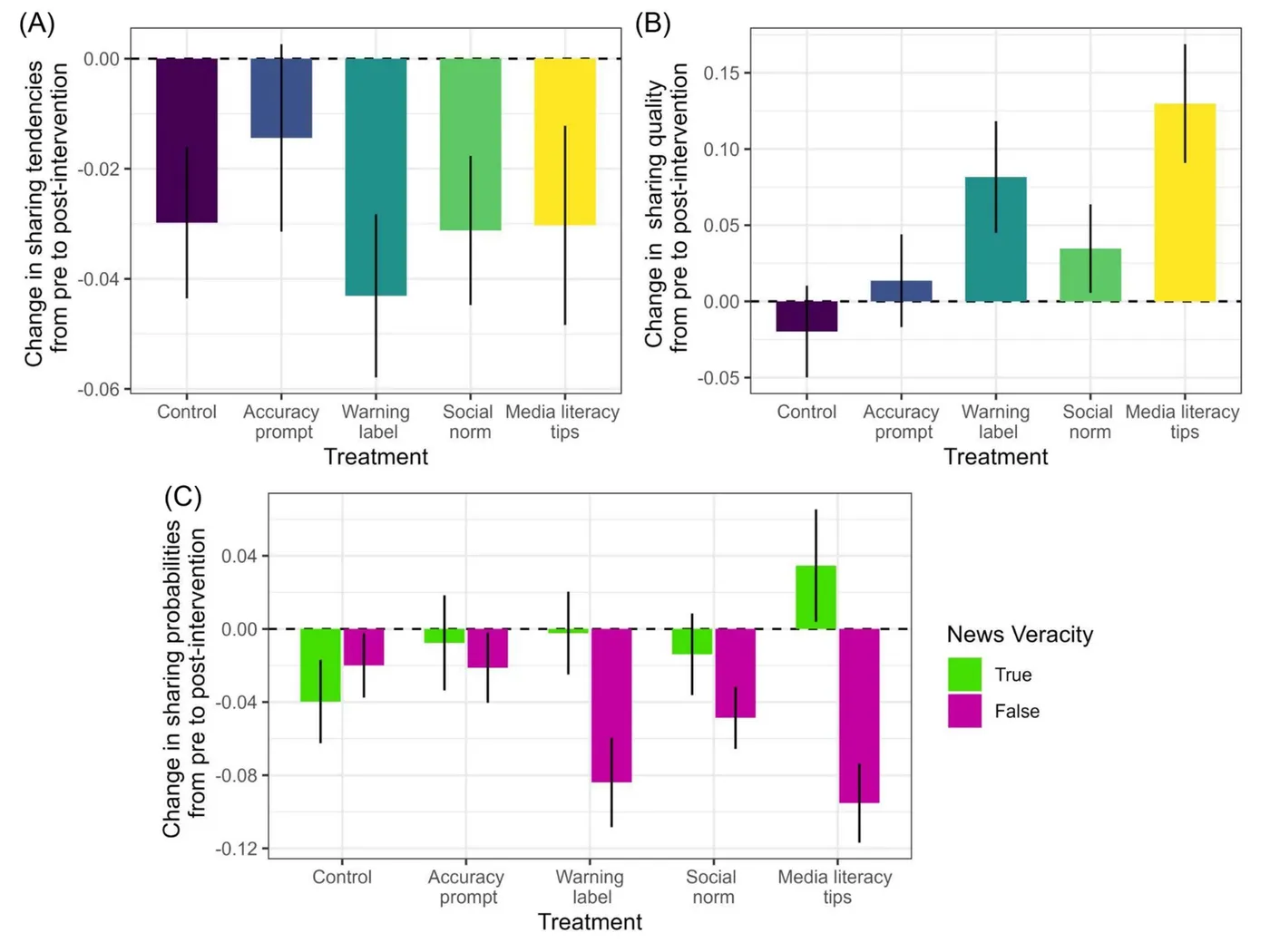
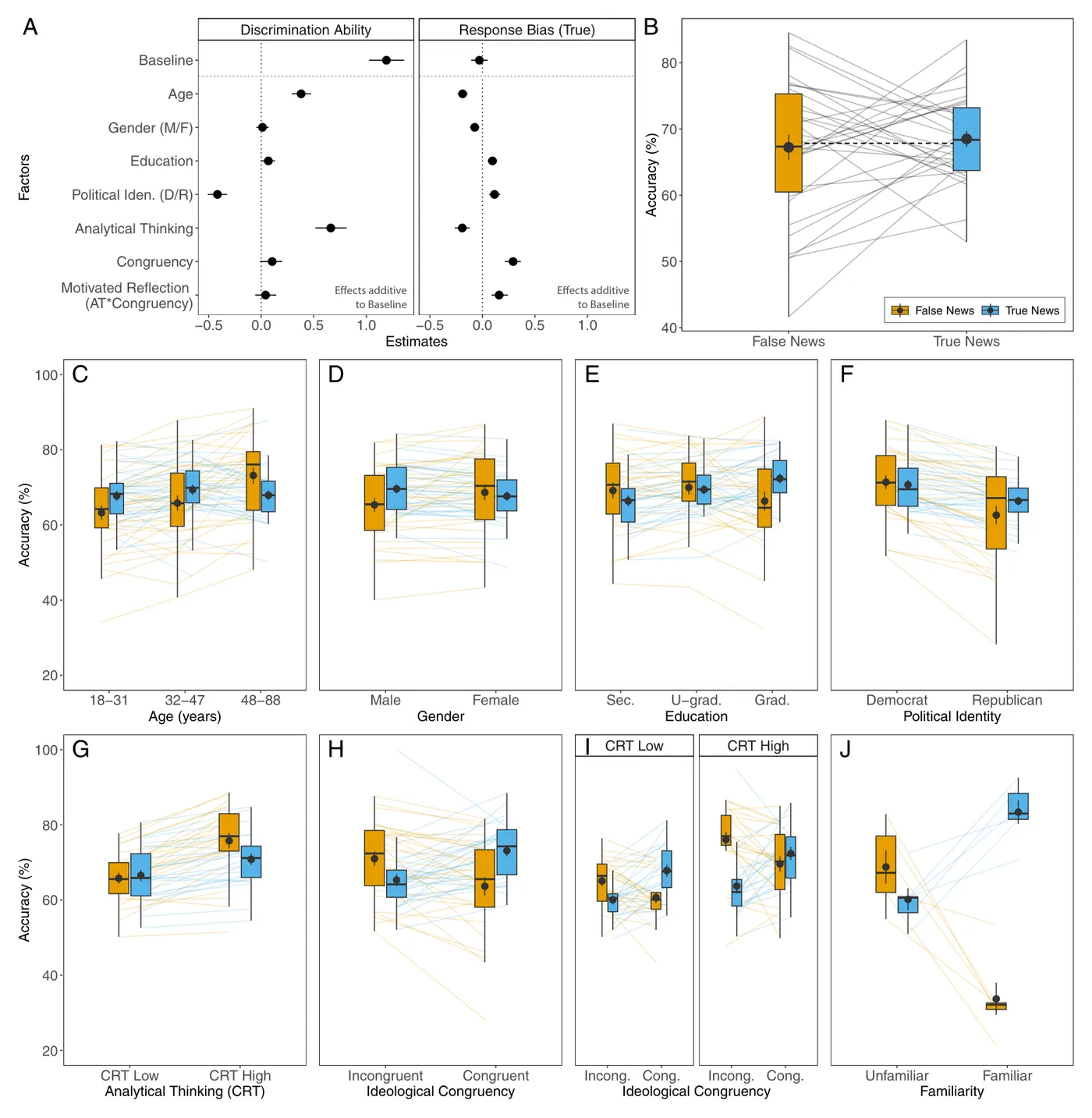
Figure from “Toward a mechanistic understanding of false news sharing: Which interventions work best, for whom, and why”

Proceedings of the National Academy of Sciences · 2024

Susceptibility to Online Misinformation: A Systematic Meta-Analysis of Demographic and Psychological Factors

Sultan, M., Tump, A. N., Ehmann, N., Lorenz-Spreen, P., Hertwig, R., Gollwitzer, A., & Kurvers, R.

This meta-analysis investigates susceptibility to misinformation, analyzing data from over 250,000 news judgments by U.S. participants. The study examines who can accurately identify true and false news, revealing that older adults, Democrats, and individuals with strong analytical thinking skills tend to have better accuracy. However, biases emerge: people more readily believe news that aligns with their political views or feels familiar. Republicans benefit more from having source information displayed, while overall, stronger critical thinking skills correlate with caution toward misinformation. The findings highlight the need for interventions that encourage unbiased, critical evaluation across demographics to counter misinformation.

Figure from “Susceptibility to Online Misinformation: A Systematic Meta-Analysis of Demographic and Psychological Factors”

British Journal of Social Psychology · 2024

Intellectual humility as a tool to combat false beliefs: An individual-based approach to belief revision

Gollwitzer, A., Bao, E., & Oettingen, G.

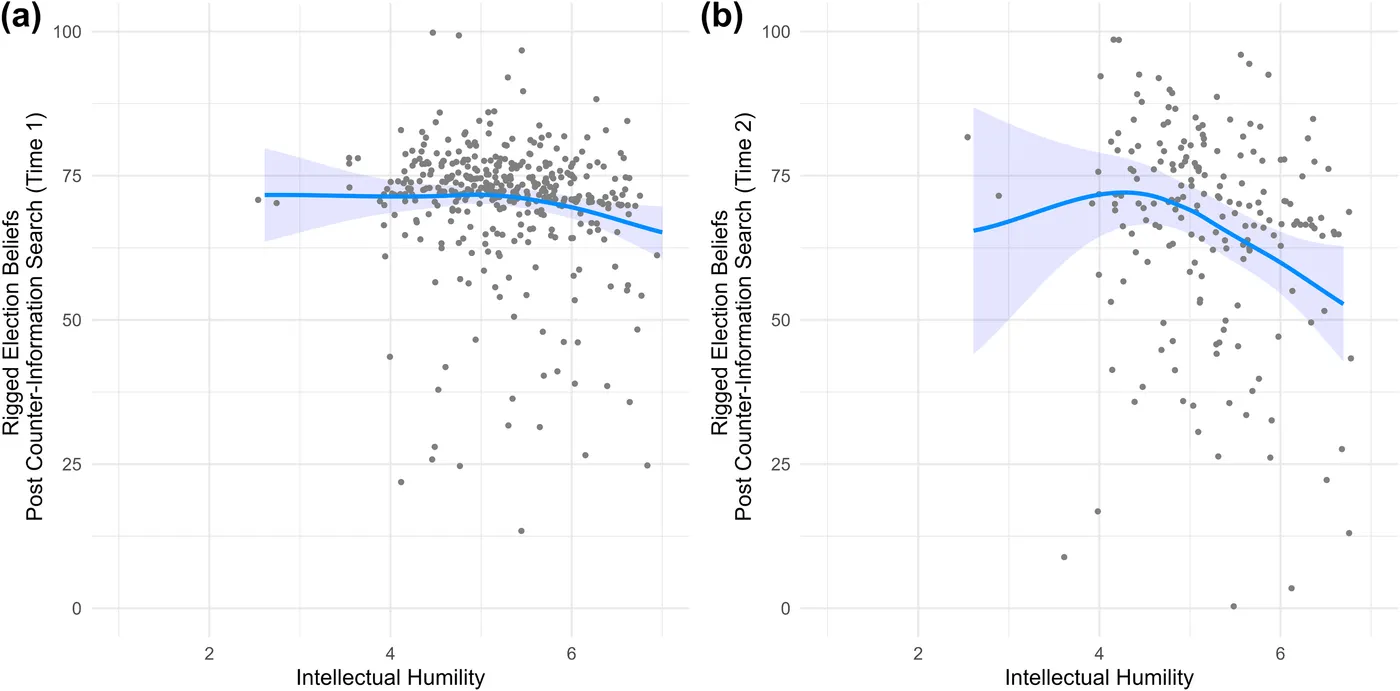
False beliefs threaten society by fueling health risks, political polarization, and violence. Our studies involving 884 participants investigated if intellectual humility (IH)—recognizing one’s knowledge limits—helps correct false beliefs through exposure to opposing information. We found that individuals with higher IH were more open to opposing views on vaccine risks and election integrity, which led to some belief revision. However, IH’s direct influence on changing false beliefs was unclear, indicating the need for alternative strategies against misinformation.

Figure from “Intellectual humility as a tool to combat false beliefs: An individual-based approach to belief revision”

Social and Personality Psychology Compass · 2023

Intellectual humility predicts COVID-19 preventive practices through greater adoption of data-driven information and feelings of responsibility

Ryu, Y., Olcaysoy Okten, I., Gollwitzer, A., & Oettingen, G.

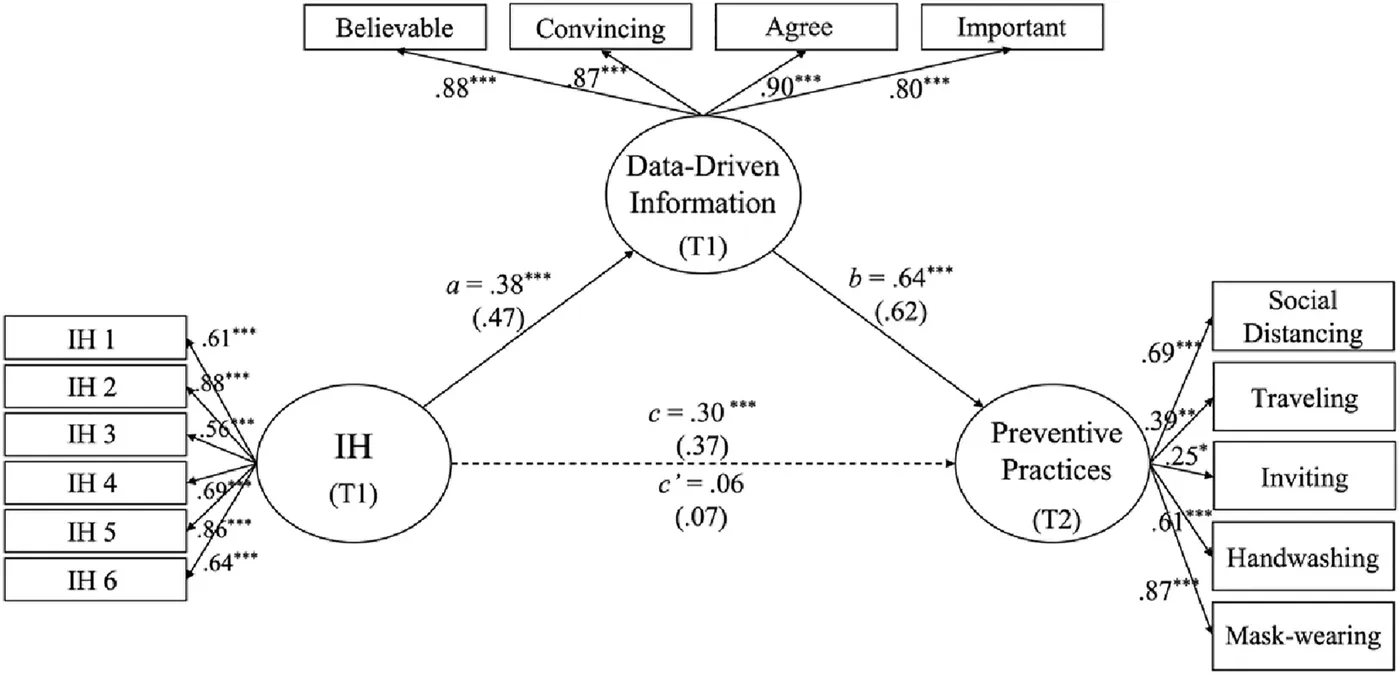
Two studies find that intellectual humility—the openness to the possibility of being wrong—leads to better adherence to COVID-19 preventive measures like social distancing, hand washing, and mask-wearing. This happens mainly because intellectually humble people are more likely to trust data-driven sources like medical experts, and feel more responsible for COVID-19 outcomes. This suggests that intellectual humility plays a key role in informed decision-making during public health crises.

Figure from “Intellectual humility predicts COVID-19 preventive practices through greater adoption of data-driven information and feelings of responsibility”